
| Movie Fact | Details |
|---|---|
| Title | The Panic in Needle Park |
| Cannes Premiere | May 21, 1971 |
| France Release | June 1, 1971 |
| U.S. Release | July 13, 1971 in New York City; July 30, 1971 in Los Angeles |
| Genre | Drama |
| Director | Jerry Schatzberg |
| Producer | Dominick Dunne |
| Screenplay | Joan Didion and John Gregory Dunne |
| Based On | James Mills’ 1966 novel The Panic in Needle Park |
| Distributor | 20th Century Fox |
| Country | United States |
| Language | English |
| Runtime | 110 minutes |
| Estimated Budget | About $1.645 million |
| Original Box Office | Original 1971 U.S. gross is not reliably reported by major box-office databases |
| Reported Revenue | Some secondary databases report about $2.2 million worldwide; this figure is not consistently verified by major box-office trackers |
| Main Cast | Al Pacino, Kitty Winn, Alan Vint, Richard Bright |
| Al Pacino’s Character | Bobby |
| Kitty Winn’s Character | Helen |
| Setting | Upper West Side, Manhattan, New York City |
| Filming Area | Sherman Square and other Manhattan locations |
| Pacino Career Significance | His first leading role in a feature film |
| Major Recognition | Kitty Winn won Best Actress at the 1971 Cannes Film Festival |
| IMDb Rating | Around 7.1/10 at the time checked |
| Rotten Tomatoes | 79% critics score and 75% audience score at the time checked |
Quick Answer
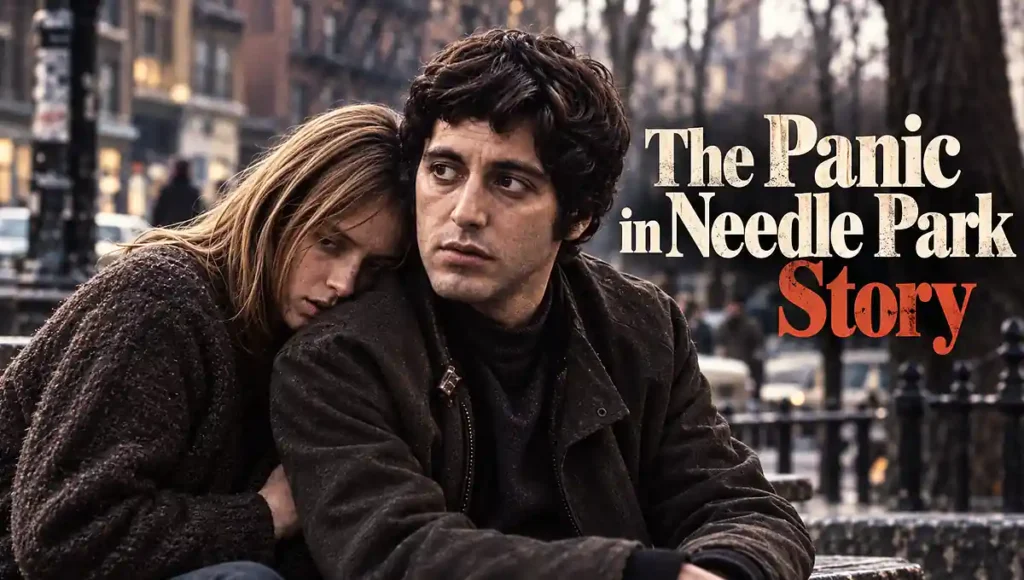
The Panic in Needle Park is a 1971 American drama directed by Jerry Schatzberg and starring Al Pacino as Bobby and Kitty Winn as Helen. Set around Manhattan’s drug scene, the film follows a young couple whose relationship becomes increasingly controlled by heroin addiction, financial desperation, crime and betrayal.
The film is particularly important in Al Pacino’s career because it gave him his first leading feature-film role. Turner Classic Movies notes that the performance later helped Francis Ford Coppola convince Paramount executives that the relatively unknown Pacino could play Michael Corleone in The Godfather.
When Was The Panic in Needle Park Released?
The Panic in Needle Park first screened at the Cannes Film Festival on May 21, 1971. It opened in France on June 1 before beginning its U.S. theatrical run in New York City on July 13, 1971, followed by Los Angeles on July 30.
The film was distributed domestically by 20th Century Fox and runs for approximately 110 minutes. It was produced in the United States and filmed extensively on real New York locations, an approach that contributed to its gritty and observational visual style.
How Much Did The Panic in Needle Park Cost and Earn?
IMDb lists the film’s estimated production budget at approximately $1.645 million. That figure gives useful context for the scale of the production, particularly because this was a serious character drama rather than a large commercial studio spectacle.
Its original 1971 box-office performance is less straightforward. Major historical box-office databases such as Box Office Mojo and The Numbers do not currently provide a reliable original U.S. theatrical gross. Some secondary movie databases report worldwide revenue of roughly $2.2 million, but because that figure is not consistently supported by the major trackers, it is better treated as a reported estimate rather than a confirmed total.
This distinction matters when discussing older films. Box-office records from the early 1970s are not always as complete or standardized as modern theatrical data, so an exact earnings figure should not be presented as certain when the underlying records disagree.
What Is The Panic in Needle Park About?
The story centres on Bobby, a young heroin user and small-time dealer, and Helen, a vulnerable young woman who becomes emotionally attached to him. What begins as companionship slowly becomes a relationship shaped by addiction, dependency and an increasingly desperate search for money.
Helen initially enters Bobby’s world from the outside, but that distance gradually disappears. As heroin takes a greater hold on both characters, their relationship becomes less about affection and more about surviving the next stage of the addiction cycle.
Rotten Tomatoes describes Bobby and Helen as becoming increasingly dependent both on heroin and on each other, with crime and betrayal following as their need for money grows. The movie does not present their lifestyle as glamorous; Jerry Schatzberg instead stays close to the routines and consequences of addiction.
Al Pacino as Bobby
For viewers exploring Al Pacino movies, The Panic in Needle Park is one of the most important early titles in his filmography. Pacino had already appeared briefly in Me, Natalie in 1969, but Bobby was the first feature-film character that allowed him to carry a substantial part of a movie.
Pacino plays Bobby as charming, streetwise and emotionally unpredictable. He can appear caring toward Helen in one moment, then selfish, anxious or manipulative in another, which prevents the character from becoming a simple stereotype of a drug addict.
TCM identifies the film as Pacino’s first movie lead role, an important distinction because it is sometimes incorrectly described as his first movie altogether.
How Bobby Differs From Michael Corleone
Bobby is far removed from the tightly controlled Michael Corleone Pacino would play only a year later. He is impulsive, restless and visibly shaped by the instability of the streets around him, while Michael often communicates power through restraint and silence.
Seeing the two performances close together makes Pacino’s early range easier to appreciate. The transition from Bobby to Michael also helps explain why The Panic in Needle Park remains more than an obscure early credit.
Kitty Winn as Helen
Kitty Winn is equally important to the film because Helen provides the emotional route through which the audience enters Bobby’s world. Her decline is gradual rather than sudden, making the character believable and giving the film much of its emotional weight.
Winn avoids turning Helen into a melodramatic victim. Her performance shows loneliness, attachment, fear and dependency building slowly, which makes the later stages of the relationship more disturbing without relying on exaggerated dialogue.
Her work received major international recognition when she won Best Actress at the 1971 Cannes Film Festival. That recognition also shows why the movie should not be viewed solely as an early showcase for the future star Al Pacino.
The Panic in Needle Park Cast
IMDb lists Al Pacino, Kitty Winn and Alan Vint among the principal stars, with Richard Bright, Kiel Martin, Warren Finnerty, Marcia Jean Kurtz and Raúl Juliá among the supporting cast.
| Actor | Character |
|---|---|
| Al Pacino | Bobby |
| Kitty Winn | Helen |
| Alan Vint | Hotch |
| Richard Bright | Hank |
| Kiel Martin | Chico |
| Warren Finnerty | Sammy |
| Marcia Jean Kurtz | Marcie |
| Raúl Juliá | Marco |
Richard Bright is particularly notable for Pacino fans because he later appeared as Al Neri in The Godfather films, creating another connection between this early movie and Pacino’s breakthrough years.
What Was “Needle Park”?
“Needle Park” was not the official name of a New York City park. The nickname referred to the Sherman Square and Verdi Square area on Manhattan’s Upper West Side, around Broadway and the West 70s, where drug users were known to gather during that period.
The movie’s use of real Manhattan locations gives the story much of its authenticity. Streets, apartments, cafés and public spaces do not function merely as scenery; they become part of Bobby and Helen’s everyday existence.
This location-based filmmaking also connects the movie with the emerging New Hollywood movement, when American directors increasingly embraced real locations, morally complicated characters and less polished visual styles.
The Book and Writers Behind the Movie
The Panic in Needle Park was adapted from the 1966 novel by James Mills. The screenplay was written by Joan Didion and John Gregory Dunne, two writers who became major names in American literary and cultural journalism.
Their screenplay concentrates heavily on behaviour and relationships rather than building the film around a conventional thriller structure. Much of the tension comes from watching Bobby and Helen repeat destructive patterns while becoming increasingly dependent on each other.
Jerry Schatzberg’s Realistic Style
Director Jerry Schatzberg came from a photography background, and his visual approach often makes the movie feel observational rather than carefully polished. Cinematographer Adam Holender supports this street-level style with location-based imagery that fits the Manhattan setting.
Instead of explaining addiction through narration or moralizing speeches, the camera frequently observes repetitive behaviour. Searching for money, finding heroin, waiting and using become part of a cycle that shapes both the film’s rhythm and its characters.
Why the Movie Was Controversial
The film was unusually direct in showing heroin addiction for a mainstream American production released in 1971. Its depiction of intravenous drug use contributed to its reputation as a difficult and confronting movie.
Some critics praised the film for refusing to glamorize addiction, while others found its repeated cycle of drug use, desperation and damaged relationships emotionally exhausting.
Modern ratings remain generally positive rather than universally enthusiastic. Rotten Tomatoes currently shows a 79% critics score and 75% audience score, while IMDb lists the movie at roughly 7.1/10. Because these user- and critic-based figures can change, they are best understood as ratings at the time checked.
How The Panic in Needle Park Helped Al Pacino Get The Godfather
The strongest connection between this film and Pacino’s later career is Francis Ford Coppola’s interest in his performance. Pacino was not yet a major Hollywood star, and Paramount executives were initially uncertain that he was the right choice for Michael Corleone.
Coppola used Pacino’s work in The Panic in Needle Park to help make his case. Only a year later, Pacino appeared in The Godfather and moved from promising New York actor to international movie star.
Anyone following all the Godfather movies can see how quickly his career changed. The progression from Me, Natalie to The Panic in Needle Park and then The Godfather happened within only a few years.
Why The Panic in Needle Park Matters in Al Pacino’s Career
The film captures Pacino before his public image had been defined by Michael Corleone, Tony Montana or the larger performances associated with his later career. Bobby feels raw, unstable and less controlled, allowing viewers to see a different side of the actor.
The movie also helped launch a career that would eventually include decades of major films, awards and substantial earnings, explored separately in Al Pacino’s net worth. Its real importance, however, is that Pacino proved he could carry a serious feature film before Hollywood fully understood how significant his career would become.
Critical Reception and Legacy
The Panic in Needle Park never became as commercially famous as The Godfather, Scarface or Heat, but popularity is only one way to measure a film’s importance. Its reputation rests on its performances, realistic depiction of addiction and place within early-1970s New Hollywood cinema.
The creative team also gives the film lasting historical interest: Jerry Schatzberg directed, Joan Didion and John Gregory Dunne wrote the screenplay, Dominick Dunne produced, Adam Holender handled cinematography, and Kitty Winn earned major Cannes recognition.
For Pacino fans, however, its importance is particularly straightforward. This was the first time movie audiences saw him carry a feature film, and the performance directly helped open the door to the role that changed his career.
Is The Panic in Needle Park Worth Watching?
The film is worth watching for viewers interested in Al Pacino’s early career, New Hollywood, 1970s New York cinema or realistic character dramas about addiction. It is very different from Scarface or The Godfather, with no crime empire, glamorous criminal lifestyle or large-scale action.
Its strength comes from intimacy and discomfort rather than spectacle. Pacino gives an early leading performance full of charm and instability, while Kitty Winn provides the emotional centre of a relationship gradually damaged by heroin dependence.
More than five decades after its release, The Panic in Needle Park remains important because it captures both a particular New York environment and a crucial moment in Pacino’s development. It is the film in which he became a leading actor just before The Godfather made him a star.

1 Pingback