All The Godfather Movies: Cast, Story and Al Pacino’s Iconic Role
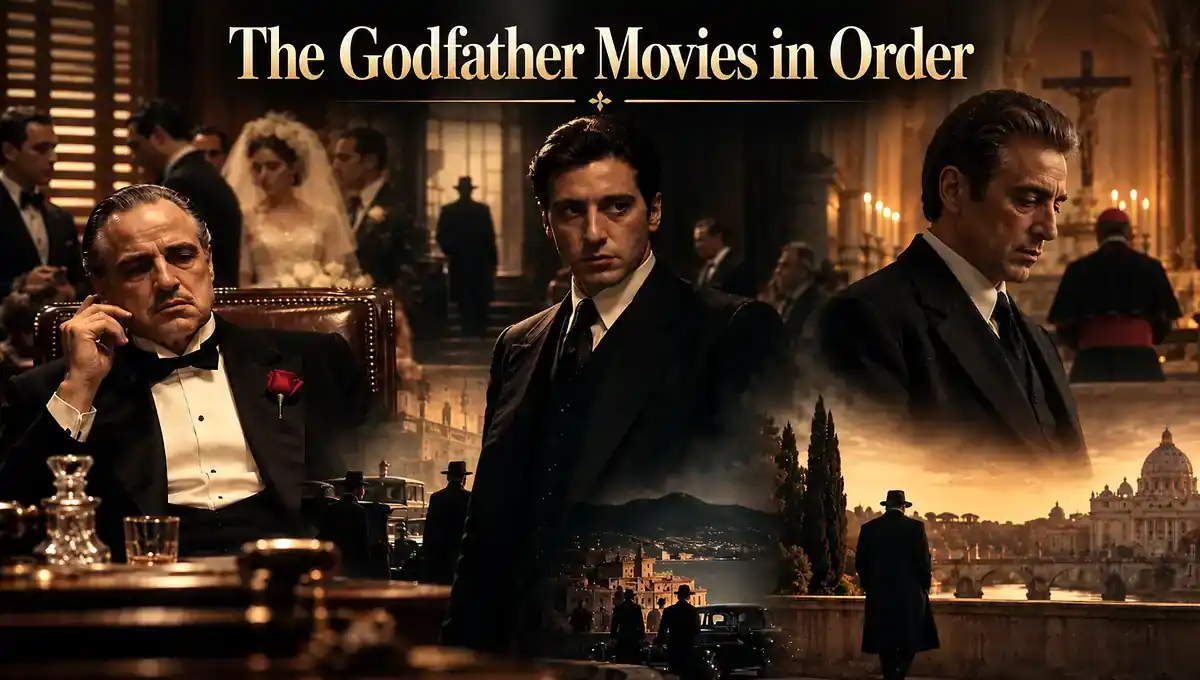
There are three original Godfather movies: The Godfather (1972), The Godfather Part II (1974), and The Godfather Part III (1990). Francis Ford Coppola directed all three films, while Al Pacino played Michael Corleone throughout the trilogy.
Although the story begins with Don Vito Corleone at the center of the family, the larger trilogy gradually becomes Michael’s story. Viewers watch him move from a young man who wants a life outside the family business to the powerful head of the Corleone family, and finally to an older man trying to live with the consequences of his choices.
The Godfather Movies at a Glance
| Fact | Details |
|---|---|
| Number of original movies | 3 |
| First movie | The Godfather (1972) |
| Second movie | The Godfather Part II (1974) |
| Third movie | The Godfather Part III (1990) |
| Director | Francis Ford Coppola |
| Main character across trilogy | Michael Corleone |
| Michael Corleone actor | Al Pacino |
| Vito Corleone in Part I | Marlon Brando |
| Young Vito Corleone in Part II | Robert De Niro |
| Based on | Mario Puzo’s novel The Godfather |
| The Godfather Coda | Revised version of Part III |
| Part I Oscar wins | 3 |
| Part II Oscar wins | 6 |
| Part III Oscar wins | 0 from 7 nominations |
How Many Godfather Movies Are There?
There are three movies in the original Godfather film series. The correct viewing order is also their release order:
- The Godfather — 1972
- The Godfather Part II — 1974
- The Godfather Part III — 1990
Watching them in this order makes Michael Corleone’s story easiest to follow. Part II moves between two periods because it also shows the early life of Vito Corleone, but Michael’s story continues directly from the events of the first movie.
Some viewers become confused by The Godfather Coda: The Death of Michael Corleone, released in 2020. It is not a fourth movie. It is Francis Ford Coppola’s revised version of The Godfather Part III.
The Godfather (1972)
The Godfather was released in 1972 and introduced audiences to the Corleone family. Francis Ford Coppola directed the film and co-wrote the screenplay with Mario Puzo, whose 1969 novel provided the basis for the story.
Marlon Brando plays Don Vito Corleone, the aging head of a powerful New York crime family. His youngest son, Michael Corleone, initially appears to want little involvement in the family business.
Michael has served in the military, has a relationship with Kay Adams, and seems determined to build a different life. That changes after an attack on his father pulls him into the conflict surrounding the Corleone family.
As events become more violent, Michael begins making decisions that push him deeper into the world he once tried to avoid. By the end of the film, his position inside the family has changed completely.
The main cast includes Marlon Brando as Vito Corleone, Al Pacino as Michael, James Caan as Sonny, John Cazale as Fredo, Robert Duvall as Tom Hagen, Diane Keaton as Kay Adams and Talia Shire as Connie Corleone.
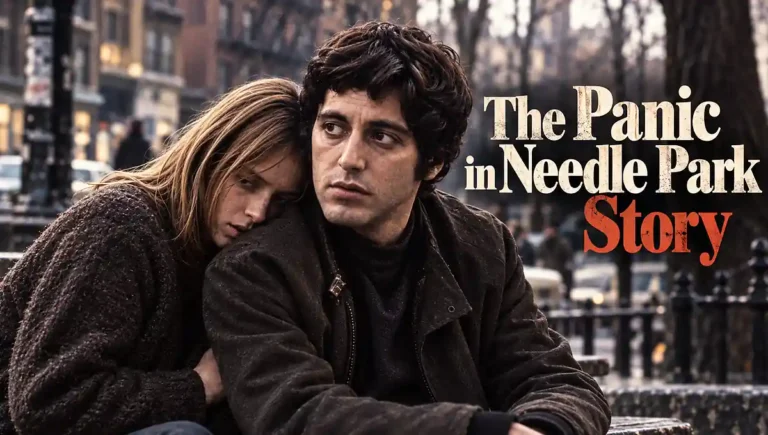
For Pacino, the film came at an important point in his early screen career. His first major leading movie role had been in The Panic in Needle Park in 1971, where his performance helped Francis Ford Coppola see him as a strong choice for Michael Corleone.
Pacino was still far from an established Hollywood star when filming began. Studio executives were initially uncertain about his casting, and Pacino later described a period during production when he believed he could lose the role.
That uncertainty makes his eventual place at the center of the trilogy more interesting. Michael Corleone became the character that connected all three films and changed the direction of Pacino’s movie career.
The Godfather Part II (1974)
The Godfather Part II arrived only two years after the first movie, but its structure is very different. Instead of following one period, the film tells two connected stories.
One storyline continues Michael Corleone’s life after he has become head of the family. The other moves backward in time and follows the younger Vito Corleone as he builds a life in New York.
Al Pacino returns as Michael, while Robert De Niro plays young Vito. This means two different actors portray Vito Corleone across the series: Marlon Brando as the older Vito in the first movie and De Niro as the younger version in Part II.
Michael now has far more power than he did in the first film, but his family relationships are becoming increasingly damaged. His marriage to Kay is under severe pressure, while his relationship with his brother Fredo becomes one of the most important parts of the story.
The contrast between Michael and his father gives Part II much of its emotional weight. Vito’s storyline shows a family being built, while Michael’s shows that family becoming increasingly divided under his leadership.
Robert Duvall returns as Tom Hagen, Diane Keaton as Kay, John Cazale as Fredo and Talia Shire as Connie. Lee Strasberg also appears as Hyman Roth, a businessman who becomes deeply involved in Michael’s plans.
The Godfather Part II won six Academy Awards, including Best Picture. Robert De Niro won Best Supporting Actor for playing young Vito Corleone, while Francis Ford Coppola won Best Director.
The Godfather Part III (1990)
The third movie arrived in 1990, sixteen years after Part II. Michael Corleone is now much older and no longer simply focused on increasing his power.
Instead, he wants to move the Corleone family away from crime and turn its business interests into legitimate operations. The problem is that leaving his old world proves far more difficult than entering it.
Michael also carries years of regret. His past decisions continue to affect his relationship with Kay, his children and other members of the family.
Al Pacino returns as Michael, with Diane Keaton again playing Kay and Talia Shire returning as Connie. Andy Garcia joins the series as Vincent Mancini, the son of Sonny Corleone.
Vincent becomes increasingly important as Michael looks toward the future of the family. Sofia Coppola plays Michael’s daughter Mary, whose relationship with Vincent becomes part of the film’s family conflict.
The third movie received seven Academy Award nominations, including Best Picture and Best Director, but it did not win an Oscar.
What Is The Godfather Coda?
In 2020, Francis Ford Coppola released Mario Puzo’s The Godfather, Coda: The Death of Michael Corleone.
Despite having a different title, Coda is not The Godfather Part IV. It is a re-edited version of The Godfather Part III.
Coppola changed the opening and ending and rearranged some scenes, shots and music. The goal was to present the final part of Michael Corleone’s story in a way closer to how Coppola wanted it structured.
The central characters and basic story remain connected to Part III. Someone who has watched the original trilogy does not need to treat Coda as an entirely separate sequel.
Al Pacino as Michael Corleone
Michael Corleone is the central link between all three Godfather movies. The role also became one of the most important parts of Al Pacino’s acting career.
What makes Michael interesting across the trilogy is how much he changes. In the first movie, he appears to be the Corleone son most capable of building a life outside the family business.
By the end of that film, he has moved in the opposite direction.
Part II shows Michael with greater control but less emotional connection to the people around him. His decisions protect his authority while damaging important family relationships.
Part III gives viewers a much older Michael who wants something different. He is no longer trying simply to become stronger; he is trying to separate himself and his family from the world he helped maintain.
Readers who want to see where the Godfather films fit within his wider career can also explore our complete guide to Al Pacino movies.
Pacino was born on April 25, 1940, which means he was 31 when The Godfather reached cinemas in 1972. The contrast between that young Michael and the much older version seen in Part III also helps the trilogy feel like one long character story rather than three disconnected crime films.
Main Cast Across The Godfather Movies
| Actor | Character | Movie appearances |
|---|---|---|
| Al Pacino | Michael Corleone | Parts I, II and III |
| Marlon Brando | Vito Corleone | Part I |
| Robert De Niro | Young Vito Corleone | Part II |
| Diane Keaton | Kay Adams / Corleone | Parts I, II and III |
| James Caan | Sonny Corleone | Part I, brief Part II appearance |
| John Cazale | Fredo Corleone | Parts I and II |
| Robert Duvall | Tom Hagen | Parts I and II |
| Talia Shire | Connie Corleone | Parts I, II and III |
| Andy Garcia | Vincent Mancini | Part III |
| Sofia Coppola | Mary Corleone | Part III |
One detail that often confuses new viewers is Vito Corleone. Marlon Brando plays the older Vito in the first movie, while Robert De Niro portrays him as a younger man in Part II.
Both performances received Academy Awards. Brando won Best Actor for The Godfather, while De Niro won Best Supporting Actor for The Godfather Part II.
Is The Godfather Based on a True Story?
No, The Godfather is not the true story of one real Mafia family.
The movies are based on Mario Puzo’s 1969 novel The Godfather. The Corleone family, including Vito and Michael Corleone, is fictional.
Puzo researched organized crime while developing the novel, which helped create a world that felt believable. Some characters and events also have similarities to people and incidents from real American Mafia history.
That does not make the Corleones a real family or turn the movie into a biography of actual mob figures. A more accurate description is that The Godfather is fictional storytelling influenced by real organized-crime history.
Academy Awards Across the Trilogy
The first two Godfather movies received especially strong recognition at the Academy Awards.
The Godfather won three Oscars, including Best Picture, Best Actor for Marlon Brando, and Best Adapted Screenplay for Mario Puzo and Francis Ford Coppola.
The Godfather Part II went further with six wins. Its awards included Best Picture, Best Director for Coppola, Best Supporting Actor for Robert De Niro and Best Adapted Screenplay.
This also created an unusual acting connection between the first two movies. Marlon Brando and Robert De Niro both won Oscars for playing Vito Corleone, but at different stages of the character’s life.
The Godfather Part III received seven nominations but did not win.
How Much Did The Godfather Movies Cost and Earn?
The original Godfather was made on a relatively modest budget compared with major films today. Historical sources commonly place its production cost at roughly $6 million to $7 million.
Modern box-office databases report approximately $250 million to $270 million worldwide for the film when later releases are included. Exact historical totals vary because different databases count international releases and re-releases differently.
The Godfather Part II reportedly cost about $13 million to produce. Modern databases place its tracked worldwide theatrical total at roughly $48 million to $58 million, again depending on which releases are included.
The Godfather Part III had a much larger reported budget of around $54 million. Historical worldwide totals differ significantly between current databases, so one exact figure should not be treated as a confirmed final accounting number.
These movie grosses also have nothing to do with Pacino’s personal net worth. Ticket sales are studio revenue figures, not an actor’s take-home income. His finances are covered separately in our article about Al Pacino’s net worth.
Is There a Godfather 4?
There is currently no released The Godfather Part IV.
The original movie series remains a trilogy consisting of The Godfather, The Godfather Part II and The Godfather Part III.
Coda does not change that count because it is a revised version of the third film rather than a new continuation of the story.
If you are watching the series for the first time, the easiest order is:
The Godfather → The Godfather Part II → The Godfather Part III
After that, you can watch The Godfather Coda if you want to compare Coppola’s revised version of Michael Corleone’s final chapter.